 Auto Encyclo Welcome To Auto Encyclo site for reviews car
Related Articles



Road-trip anxiety in an EV rarely starts with the first hour of highway driving. It starts when the planner shows a pink charging icon and you wonder whether the stall will be broken, busy, or stuck at 40 kW while your kids ask how much longer. Ultra-fast charging was supposed to shrink that stress to a bathroom-and-coffee stop. For years, the hardware lagged the promise.
Megawatt-class charging and higher-power passenger DC networks are finally changing the math—especially for heavy trucks, and increasingly for cars that can swallow serious current. The Megawatt Charging System (MCS) is being standardized for commercial vehicles at power levels that make a lunch break meaningful again. Parallel to that, passenger networks are pushing 350–600 kW class cabinets, and some markets are demonstrating multi-megawatt passenger charging peaks. Here is what that rise means for your next long drive.
Why Road Trips Felt Harder Than Daily Commutes
Home charging hides a lot of friction. On the highway, you depend on public power density, payment reliability, and whether your car’s battery chemistry will actually accept high power when it is hot, cold, or already half full. A “250 kW” station label does not guarantee a 250 kW session. Cable limits, shared cabinets, and conservative battery management often deliver less.
Anxiety compounds when the next reliable site is 80 miles farther than the app suggested. Ultra-fast charging helps only when three pieces align: the grid connection, the dispenser, and the vehicle’s acceptance curve. Megawatt technology attacks the first two for big batteries; vehicle design has to keep up for the third.
Expert Insight From Real Stops
The best road-trip EV experiences are boring: plug in, walk inside, return to a large jump in state of charge. The worst are technical debates at a stall. Power that is high and predictable beats peak numbers that only appear for sixty seconds.
What “Megawatt Charging” Really Refers To
In industry language, the Megawatt Charging System is a high-power DC standard aimed first at large commercial vehicles—Class 6–8 trucks and buses—with design targets up to roughly 3.75 MW (on the order of 1,250 V and very high current). MCS connector work has moved through CharIN-led development into formal standardization steps in 2026, with interoperability testing ongoing as fleets pilot heavy-duty routes.
That matters to car drivers indirectly and directly. Indirectly, freight electrification funds corridor upgrades and teaches utilities how to site huge loads. Directly, some high-power site architectures and liquid-cooled cables overlap with next-generation passenger stalls. Passenger cars today still primarily use CCS or NACS connectors with lower current limits than full MCS, even when the site can feed serious power to a truck bay nearby.
Hypothetical Truck-Stop Future
A highway plaza runs MCS lanes for regional haulers that recharge during mandatory rest. Adjacent car stalls offer 400 kW-class sessions for 800-volt passenger EVs. You may never pull an MCS handle, yet the plaza exists because freight demanded the service upgrade.
Passenger Ultra-Fast: The Practical Anxiety Fix
For most personal road trips, the near-term relief is denser 350 kW-plus sites and vehicles designed around 800-volt architectures that hold higher power longer. Newer premium EVs are advertising charge powers in the 400 kW class; networks in various regions list cabinets at 400–600 kW. In some markets, manufacturers have demonstrated passenger charge rates approaching or exceeding a megawatt under controlled conditions—impressive engineering that still has to translate into widespread public hardware and battery warranties you can trust.
The ownership win is time. Cutting a 35-minute lag to a 15-minute lag changes whether you plan one stop or two. It does not eliminate the need to precondition the battery, arrive below a high state of charge when you want peak power, or pick stalls that are actually online.
What Still Caps Your Session
Cell temperature, state of charge, cable rating, and how many vehicles share one power cabinet still govern outcomes. Ultra-fast infrastructure reduces the ceiling constraint; driving habits and car design decide whether you touch that ceiling.
Grid Reality: Power Without Breaking the Substation
Megawatt stalls are not just bigger plugs. They are utility projects. Sites increasingly pair high-power dispensers with battery buffers so a limited grid connection can still deliver short bursts above the average draw. Research projects have shown megawatt-class output supported partly by on-site storage while the grid feed stays lower—exactly the kind of engineering that makes remote highway plazas feasible.
Without storage, transformers, and smart queuing, a row of ultra-fast stalls becomes a very expensive way to disappoint everyone at 5 p.m. on a holiday weekend. The rise of megawatt charging is as much about energy management as about connector pin counts.
Expert Insight for Trip Planners
Favor corridors with multiple high-power stalls per site, not a single unicorn charger. Redundancy fixes anxiety better than one world-record cabinet.
How to Use Ultra-Fast Charging on a Real Road Trip
Precondition the battery when your car offers it on the way to a DC stop. Aim to arrive with a mid-to-low state of charge if you want the highest power segment of the curve. Start the session, confirm the kilowatt rate climbs, then walk away rather than staring the number down for ten minutes.
Carry payment options the networks on your route accept. Keep a short list of backup sites 20–40 miles apart on busy holidays. If your EV is a 400-volt design with a modest peak, do not plan the entire day as if it were an 800-volt flagship—your honest curve matters more than the station’s marketing banner.
Compact Road-Trip Checklist
Preconditioning on. Arrival SoC planned. Two backup stations saved offline. App accounts logged in. Cable standard compatible (or adapter strategy clear). Cabin comfort items for a 15–25 minute window. That kit turns ultra-fast hardware into lower stress.
What This Means for the Next Car You Buy
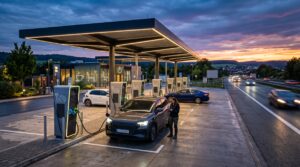
If long highway trips define your year, prioritize measured charge curves from independent tests, not only peak kW claims. Look at 10–70% time estimates under realistic temperatures. Check whether your region’s fastest networks match your connector standard without fragile adapter dependence.
Megawatt truck lanes signal where corridor investment is flowing; passenger ultra-fast stalls tell you what your car can use tomorrow morning. The anxiety fix is cumulative: more reliable sites, higher sustained power, better vehicle thermal design, and clearer apps. No single connector erases a poorly planned route.
FAQ
What is a megawatt charger?
Generally, DC equipment capable of delivering on the order of 1,000 kW or more. The MCS standard targets heavy-duty vehicles at multi-megawatt potential; passenger use is advancing through high-power CCS/NACS-class stalls and limited ultra-high-power demos.
Will my current EV charge at a megawatt?
Most passenger EVs cannot accept a full megawatt today. Peak rates depend on the car’s voltage architecture, battery, and thermal limits.
Does ultra-fast charging damage the battery?
Occasional DC fast charging is normal for trips; constant peak DC as a daily habit can increase wear depending on chemistry and management. Follow the manufacturer’s guidance.
Are megawatt chargers widely available for cars now?
Full MCS is focused on commercial vehicles and pilots. Passenger drivers benefit more immediately from expanding 350–600 kW class networks where available.
How does this reduce road-trip anxiety?
Shorter stops and more high-power stalls reduce schedule risk—when the station works and your car can accept the power.
Is this technical advice for my vehicle?
No. It is general industry education. Check your owner’s materials and local network maps for trip planning.
Faster Stops, Calmer Miles
The rise of megawatt chargers and ultra-fast public DC is fixing road-trip anxiety by attacking dwell time and corridor capability—first for heavy-duty fleets with MCS, and increasingly for passenger EVs that can hold high power on upgraded highways. Anxiety fades when a stop feels routine rather than like a gamble.
Before your next long drive, update your charging apps, precondition on approach, and pick sites with multiple high-power stalls. The hardware is getting serious. Pair it with a sober plan, and the highway stops being a test of nerves—and starts being a drive again.