 Auto Encyclo Welcome To Auto Encyclo site for reviews car
Related Articles



You have watched charging times shrink and heard promises about cars that can feed power back to the grid, yet real-world demonstrations often feel distant. At its 2026 Global Innovation Conference and related user summit in Wuhu, Chery put both ideas on display. The company showcased its Volt-Dragon ultra-fast charging system and a scaled AC vehicle-to-grid (V2G) demonstration station that combines solar generation, battery storage, and bidirectional charging. The event offered a concrete look at how Chinese manufacturers are trying to turn EVs into active energy assets rather than simple consumers of electricity.
Volt-Dragon Ultra-Fast Charging
Chery presented a high-power charging technology branded Volt-Dragon (also referred to in some materials as Xunlong Flash Charging). The system is rated at megawatt levels, with claims of adding substantial range in a very short time—manufacturer figures include the ability to deliver hundreds of kilometers of range in roughly five minutes under ideal conditions and to move a compatible battery from low to high state of charge in under seven minutes. These numbers remain manufacturer claims and depend on vehicle battery design, thermal management, and the charger’s ability to sustain peak power. The demonstration station also incorporates an “island mode” that can keep charging operational even if the upstream grid experiences disruption.
Scaled AC Vehicle-to-Grid Demonstration
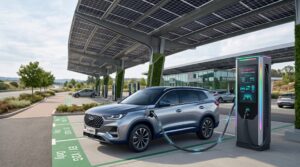
A central feature of the Wuhu site is what Chery describes as China’s first AC V2G demonstration station deployed at scale. The installation integrates photovoltaic panels, industrial-scale battery storage, and smart charging hardware into a local microgrid. Parked electric vehicles can charge during lower-cost periods and, when enabled, discharge power back to the grid during peak demand. The setup is designed to support both ultra-fast charging loads and a renewable-powered rest area for drivers. Bidirectional capability turns the vehicle battery into a distributed energy resource that can help balance the local network.
How the Energy Ecosystem Fits Together
Chery’s demonstration links three elements: on-site solar generation, stationary storage, and the vehicle itself. AI-based energy management coordinates when power is drawn from or sent to the grid, when solar output is stored, and when vehicles charge or discharge. The goal is higher self-consumption of renewable energy, lower peak-demand strain, and potential economic returns for participants through tariff differences. In parallel, Chery has pointed to a solar-plus-storage microgrid project at an electric heavy-truck facility in Spain as an example of the same principles applied outside China.
Practical Implications for Drivers
Ultra-fast charging aims to make long-distance EV travel feel closer to conventional refueling stops, provided the network expands and vehicles can accept the power levels. V2G, if widely supported by both cars and utilities, could let owners earn credits or reduce energy costs by supplying power when the grid needs it most. Hypothetical illustration: a driver who charges overnight at a low tariff and later allows limited discharge during an evening peak could offset part of their electricity bill while the vehicle still retains enough range for the next day’s commute. Realizing that scenario requires compatible vehicles, clear commercial terms, and reliable local infrastructure.
Broader Technology Context at the Event
The same conference also featured Level 4 robotaxi solutions, embodied AI robots, and other future-mobility concepts. Together they signal Chery’s ambition to present itself as a technology company spanning vehicles, energy, and autonomy. The charging and V2G demonstrations, however, are the elements most directly relevant to current EV owners and fleet operators. Plans mentioned in connection with the technology include initial deployment of Volt-Dragon stations in multiple Chinese cities and longer-term ambitions for a much larger network.
What Remains to Be Proven
Manufacturer peak-power and time-to-charge claims need independent verification under real temperature and battery-state conditions. Widespread V2G adoption depends on vehicle hardware support, utility programs, battery-warranty implications, and customer willingness to allow controlled discharge. Network density will determine whether ultra-fast charging becomes routine or remains limited to showcase locations. Buyers and fleet managers should watch for production vehicles that officially support the high-power rates and for published results from the Wuhu station’s ongoing operation.
Chery’s 2026 demonstration in Wuhu brought ultra-fast charging and scaled AC vehicle-to-grid technology into a single, working energy site. The Volt-Dragon system targets dramatically shorter charge times, while the V2G station shows how solar, storage, and bidirectional EVs can operate as a coordinated microgrid. If the claimed performance holds up in everyday use and the supporting network expands, these approaches could reduce both charging friction and the strain EVs place on the grid. Keep an eye on independent tests of the charging rates and on commercial V2G programs that turn the demonstration into something owners can actually join.
FAQ
What is Volt-Dragon charging?
Chery’s high-power ultra-fast charging technology, demonstrated with megawatt-level capability and claims of adding large amounts of range in a few minutes under optimal conditions.
What does the V2G demonstration involve?
A scaled AC vehicle-to-grid station in Wuhu that combines solar generation, battery storage, and bidirectional charging so EVs can both draw from and supply power to the grid.
Can ordinary drivers use V2G today?
The Wuhu site is a demonstration and operational pilot. Broader consumer access depends on compatible vehicles, utility programs, and commercial terms that are still developing.
How fast does Chery claim its ultra-fast system can charge?
Manufacturer figures include adding hundreds of kilometers of range in about five minutes and moving a battery from low to high state of charge in under seven minutes. Real-world results will vary.
Why does this matter beyond China?
Similar microgrid and bidirectional concepts are already being tested in other markets, including a solar-plus-storage project linked to Chery in Spain. The core ideas—faster charging and cars as grid resources—are relevant wherever EV adoption is growing.